
Why Is My Water Heater Leaking?
Quick Answer
Common sources of water heater leaks include: a failing temperature and pressure (T&P) relief valve, a worn drain valve, a loose fitting or union, or — for older tanks — corrosion in the tank itself. Condensation can look like a leak but usually isn't one. If you confirm a real leak, shut off the water supply and power/gas to the unit right away, since continuing to run a leaking water heater risks water damage and, in some cases, an electrical hazard.
Start With the Basics: Is It Actually Leaking?
Before assuming the worst, check whether the moisture around your water heater is condensation or an actual leak. Condensation is common on cold water lines or during humid weather and usually dries up on its own. Wipe the tank and surrounding fittings dry, then check back in a few hours — if moisture returns, you likely have a real leak somewhere in the system.
Common Causes of a Water Heater Leak
Common sources of water heater leaks include:
- Temperature and pressure (T&P) relief valve — this safety valve can release water if internal pressure builds up too high, or it may simply be worn and need replacing.
- Drain valve — located near the bottom of the tank, this valve can loosen or wear out over time.
- Loose fittings or unions — the connections where water lines meet the tank can loosen with age or vibration.
- Tank corrosion — over many years, the tank itself can corrode and develop a leak, which usually means the unit needs to be replaced rather than repaired.
What to Do Right Away
If you confirm an active leak, shut off the water supply to the unit at the cold water inlet valve. For electric water heaters, switch off the breaker; for gas units, turn the gas control to "off." This limits water damage and reduces safety risk while you sort out next steps.
Is It Safe to Keep Using a Leaking Water Heater?
Generally, no. Continuing to use a leaking water heater can allow the leak to worsen, cause water damage to flooring and nearby structures, and in some cases create an electrical safety hazard. It is worth addressing promptly rather than waiting to see if it gets better.
Mineral Sediment Cross-Section
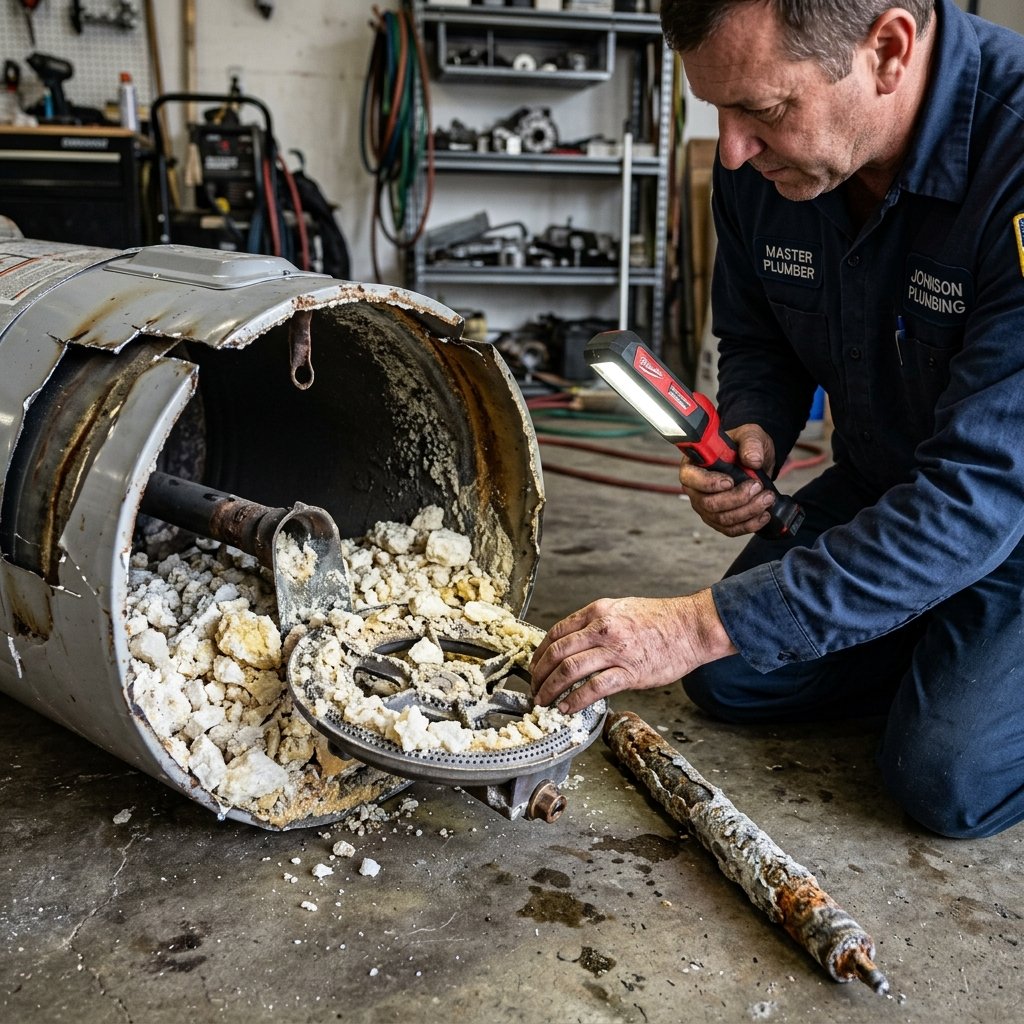
Diagnostic cross-section revealing calcium carbonate scale accumulation inside a residential storage tank, which can reduce heating efficiency and shorten element life.
Still dealing with this issue? You can request a connection with an independent local plumbing provider — there is no fee to submit a request.
Request a ConnectionFrequently asked questions
Looking for water heater repair in your area?
PlumbRoute is a referral service -- request a connection with an independent local plumber serving one of these areas:
24/7 Verified Dispatch · Phoenix AreaWater Heater Repair & Replacement in Scottsdale, AZ
24/7 Verified Dispatch · Scottsdale AreaWater Heater Repair & Replacement in Dallas, TX
24/7 Verified Dispatch · Dallas AreaWater Heater Repair & Replacement in Fort Worth, TX
24/7 Verified Dispatch · Fort Worth AreaWater Heater Repair & Replacement in Plano, TX
24/7 Verified Dispatch · Plano AreaWater Heater Repair & Replacement in Frisco, TX
24/7 Verified Dispatch · Frisco AreaWater Heater Repair & Replacement in Houston, TX
24/7 Verified Dispatch · Houston AreaWater Heater Repair & Replacement in Austin, TX
24/7 Verified Dispatch · Austin AreaWater Heater Repair & Replacement in San Antonio, TX
24/7 Verified Dispatch · San Antonio AreaWater Heater Repair & Replacement in San Diego, CA
24/7 Verified Dispatch · San Diego Area
Need help with this?
Request a connection with an independent local plumbing provider.
PlumbRoute is a referral service, not a plumbing contractor.
Request an Estimate
Tell us about your project so a local provider can follow up with pricing.